
Buying in Costa Rica
Living in Arenal
La Fortuna Costa Rica Real Estate: What to Know Before You Buy in the Arenal Region
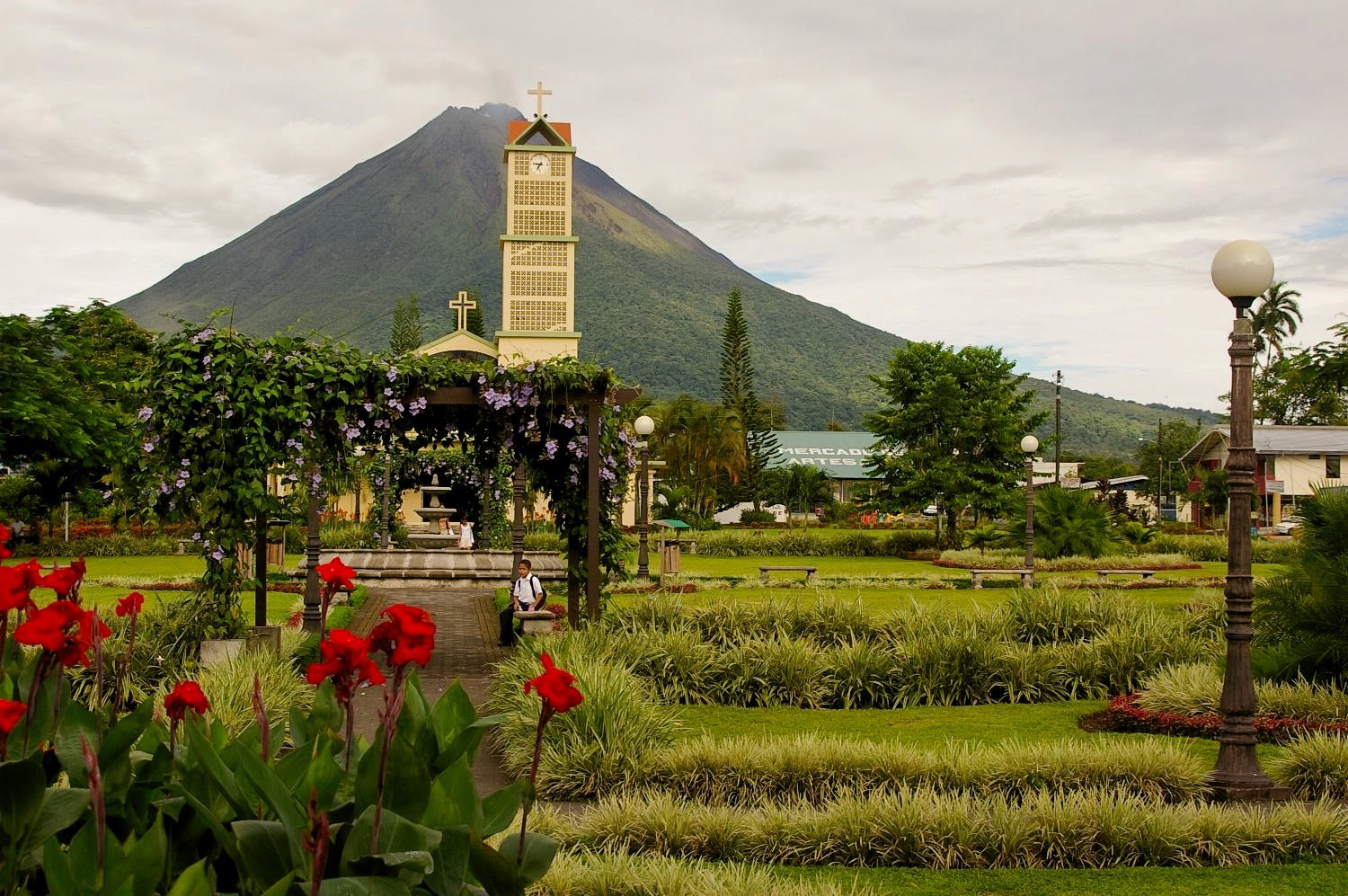
If you’re researching La Fortuna Costa Rica real estate, you’ve probably already figured out that this isn’t a market dominated by enormous developments or endless rows of nearly identical homes. Real estate here has grown much more organically around La Fortuna itself, the surrounding countryside, and the farms and communities that stretch out at the foot of Arenal Volcano.
That means you’ll find everything from individual homes and rural properties to vacation residences, building opportunities, and a smaller number of thoughtfully planned communities. Foreign buyers can own ordinary titled property here outright, just as Costa Rican citizens can, without the maritime concession rules that complicate some coastal purchases.
But finding a listing is the easy part. Buying well in the Arenal region means understanding something more specific: what does a home need to work well in this landscape? This is lush rainforest country, where greenery grows quickly, rainfall is part of the year-round rhythm, and privacy often comes courtesy of the landscape itself. Architecture, materials, drainage, maintenance, and what happens to your home while you’re away matter here.
This guide looks at the La Fortuna Costa Rica real estate market from that perspective: what kinds of properties you’ll find, the different ways you can buy, what ownership costs beyond the purchase price, and what you should know about owning a home in one of Costa Rica’s most iconic rainforest destinations.
Note: This article provides general information about buying real estate in Costa Rica and isn’t legal, tax, or financial advice. Any figures are dated where applicable, and buyers should confirm information they intend to rely on with qualified Costa Rican professionals.
What Kinds of Homes Are for Sale in La Fortuna, Costa Rica?
Search homes for sale in La Fortuna, Costa Rica, and you’ll find a market that looks very different from many of the country’s better-known coastal destinations.
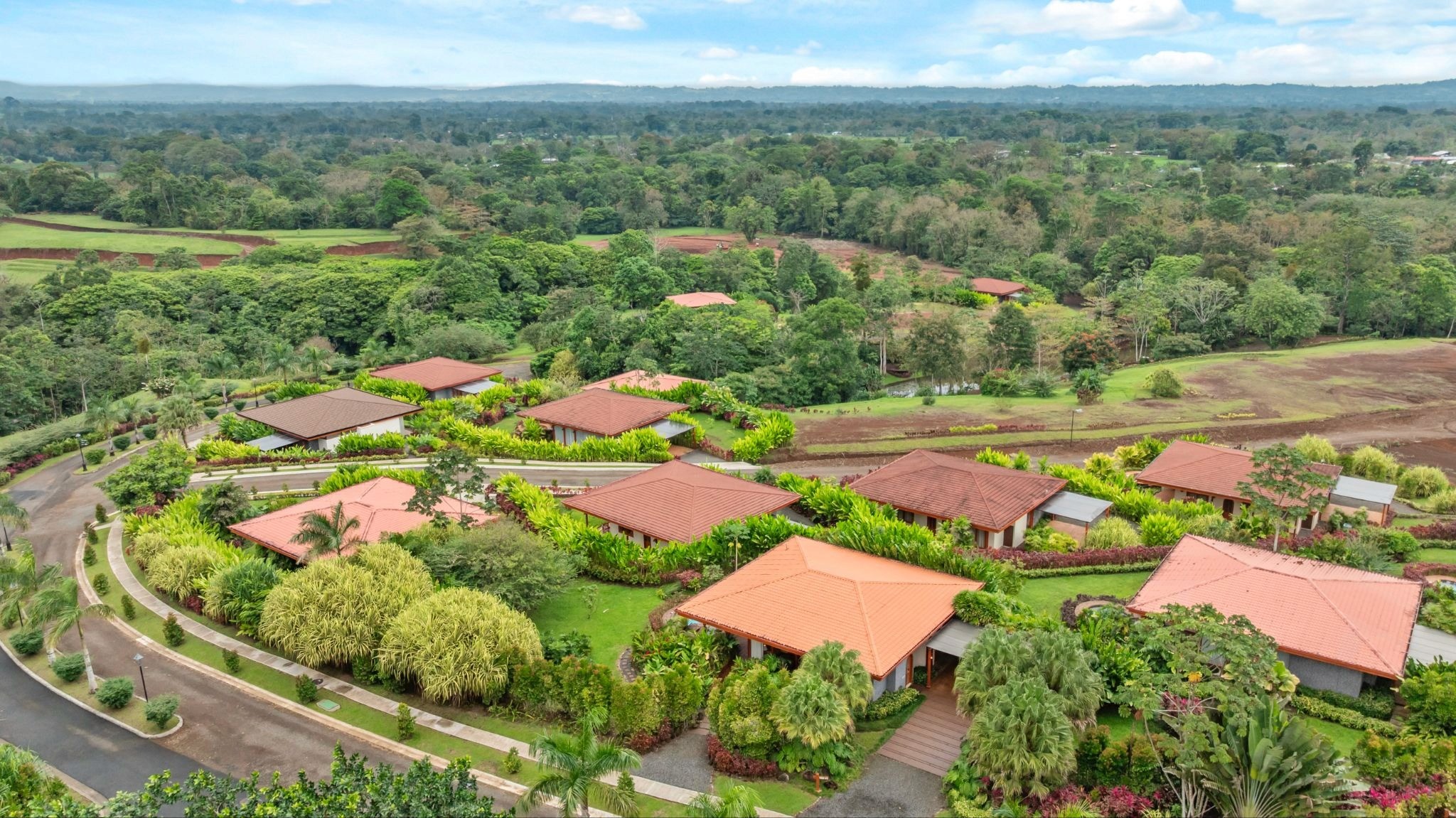
Much of the inventory is individual: standalone homes on their own lots, rural residences, vacation-rental properties, and land where a buyer can start with an architect and build independently. You’ll also find homes and villas within a smaller number of gated or planned communities, where infrastructure, maintenance, amenities, and property care may already be part of the ownership experience.
That variety is part of the appeal of Arenal Costa Rica real estate. It’s a bit of a choose-your-own-adventure, whether you gravitate to completely independent, something essentially ready for you to arrive and enjoy, or a path somewhere in between.
It’s this middle ground that’s especially worth understanding.
Three Ways to Own in the Arenal Region
Real estate buyers are often presented with two fairly obvious choices: buy something that already exists, or start from scratch and build independently. In La Fortuna and the Arenal region, there’s also a third path that sits comfortably between the two.
1. Buy an Existing Home
The most straightforward option is to buy what already exists. That may be a standalone home on its own property, a vacation residence, or an existing home within a community.
The advantage is that you can see what you’re buying, assess its condition, understand the setting, and – assuming the property checks out legally and physically – move forward without taking on a construction project. For buyers who want a relatively direct path to ownership, that simplicity can be very appealing.
2. Build Independently
At the other end of the spectrum is the fully independent build. You purchase land, hire an architect and builder, navigate permits and utilities, make dozens of design and material decisions, oversee construction, and ultimately create a home that’s entirely your own.
For the right buyer, that can be enormously rewarding. It also means taking responsibility for a significant amount of the process, particularly if you’re managing it from outside Costa Rica.
3. Choose a Guided Custom Build
Then there’s the middle ground – and for many international buyers, this is the sweet spot between the two: a guided Custom Build within an established community.
At Arenal Hills, Custom Build ownership follows a clear process:
Choose your Signature Villa Design. Start with the model home design that best fits the way you want to live.
Select a compatible homesite. Once you’ve chosen your preferred design, the team introduces you to the available homesites approved for that model.
Choose your finish level. Select from the available Silver, Gold, or Platinum finish and furnishing levels for your villa design.
Personalize within the architectural framework. You can make the home feel like your own without beginning with a blank sheet of paper or assembling the entire project yourself.
You still get the experience of choosing the home, lot and setting, and finishes that feel right for you, but the architecture, community infrastructure, construction framework, on-site care, and broader ownership environment are already established.
Bottom line: The question isn’t simply whether you want an existing home or a new one. It’s how much of the ownership process you want to build for yourself vs. how much you’d rather have thoughtfully resolved before you arrive.
What Does It Cost to Buy Property in Costa Rica?
Beyond the purchase price, Costa Rica’s standard transaction costs are fairly straightforward to plan for. The exact total depends on the property, the professionals involved, and how the purchase is structured, but these figures provide a useful starting point.
Cost | Approximate Rate | What to Know |
Property transfer tax | 1.5% | Calculated on the higher of the declared sale price or registered fiscal value |
Registry and documentary stamps | ~0.5% combined | Includes applicable fiscal, registry, and municipal stamps and charges |
Notary and legal fees | ~1%–1.5% | Costa Rican notaries are specially authorized attorneys who prepare and formalize the transfer deed |
Typical total closing costs | ~3.5%–6.5% | Varies with the transaction and scope of legal, escrow, due-diligence, corporate, and other services; allocation between buyer and seller is negotiable |
Annual municipal property tax | 0.25% | Calculated on the property’s registered taxable value |
Impuesto solidario(luxury-home tax) | Progressive, beginning at 0.25% | For 2026, applies when the taxable value of the residential construction exceeds ₡143 million |
These are planning figures rather than a quote for any particular purchase. The exact closing total can vary according to the property value, services required, applicable professional fee schedule, and the way costs are allocated between buyer and seller.
The impuesto solidario threshold is established in Costa Rican colones and reviewed periodically, so we’ve deliberately left it that way rather than converting it to a U.S. dollar figure that will move with the exchange rate.
What the table can’t tell you is what a specific property will cost to own once it’s yours. Insurance, utilities, maintenance, landscaping, property management, and any community fees all depend on the home and how you plan to use it. Those ongoing costs belong in the due diligence conversation for the individual property rather than in a one-size-fits-all estimate.
Can Foreign Buyers Own Property in La Fortuna? The Inland Advantage
Yes. For ordinary titled property in La Fortuna, foreign buyers can own real estate outright under the same basic fee-simple ownership structure available to Costa Rican citizens. You don’t need Costa Rican citizenship or residency simply to purchase and hold titled property.
Ownership is recorded in Costa Rica’s Registro Inmobiliario, or property registry, where each titled property has a folio real that identifies its registered ownership and other recorded information. We go much deeper into how that system works in our guide on can Americans buy property in Costa Rica.
Why Buying Inland Is Different From Buying on the Coast
The important geographic distinction is Costa Rica’s zona marítimo terrestre, or maritime zone. Under Ley 6043, the maritime zone generally extends 200 meters (656 feet) inland from the ordinary high-tide line:
The first 50 meters (164 feet) are public land and can’t be privately owned.
The following 150 meters (492 feet) form the restricted zone, where land is generally held through a municipal concession rather than ordinary fee-simple title.
Maritime-zone concessions are typically granted for 5 to 20 years and may be renewed, subject to the applicable rules.
Foreign ownership is more restricted within this concession system. Among other limitations, an individual foreign national generally must have at least five years of Costa Rican residency to receive a concession personally, and entities with more than 50% foreign ownership face restrictions.
La Fortuna is inland, in the canton of San Carlos in Alajuela Province, so these coastal maritime-zone rules don’t apply to ordinary titled property there.
Coastal Restricted Zone | Inland Titled Property, Including La Fortuna | |
Ownership structure | Municipal concession rather than ordinary private title | Fee-simple title |
Foreign ownership | Subject to maritime-zone residency and foreign-control restrictions | No maritime-zone foreign ownership restriction |
Registration | Governed by the municipal concession system and applicable registration requirements | Registro Inmobiliario under a folio real |
Term | Generally 5–20 years, renewable under applicable rules | Indefinite ownership |
Ongoing obligations | Concession canon and applicable taxes/fees | Applicable property taxes and other ownership costs |
That difference is easy to overlook when you’re comparing Costa Rican real estate online, but it can make the legal structure of an inland purchase considerably more familiar. In La Fortuna, you’re generally evaluating titled property rather than navigating the additional concession framework that applies to much of Costa Rica’s coastline.
This is general information about Costa Rican property law and taxation as of August 2026, not legal or tax advice. Always confirm the title, tax treatment, closing costs, and legal status of a specific property with qualified Costa Rican professionals before purchasing.
Why Homes in the Arenal Region Are Built the Way They Are
If you’re looking at La Fortuna Costa Rica real estate, one of the most important things to understand is that homes here need to respond to the landscape they’re built in.
La Fortuna sits on the Caribbean side of Costa Rica’s continental divide, where rainfall is spread more evenly across the year than it is in much of the Pacific region. Depending on the dataset, the area receives roughly 2,200 to 2,450 millimeters (86 to 96 inches) of rain annually, while relative humidity generally remains high throughout the year.
That’s part of what keeps the Arenal region so lush and beautiful. It’s also why good tropical architecture here isn’t simply about creating beautiful views of rainforest and Arenal Volcano. The best homes are designed around rain, humidity, airflow, fast-growing vegetation, and the way indoor and outdoor living actually works in this climate.
Roofs, Overhangs, and Outdoor Living
Steep roof pitches and deep overhangs may contribute to the look of a tropical home, but they also have a very practical purpose. They move water away efficiently while helping protect walls, windows, entrances, and outdoor living areas during afternoon rain.
Just as importantly, a generous covered terrace means outdoor living doesn’t disappear when the weather changes. You can still sit outside, watch the rain move through the rainforest, and use spaces that would otherwise become fair-weather-only amenities.
Drainage and Siting
Where a home sits on its land matters enormously in a region where heavy rain is simply part of the environment. Thoughtful grading, drainage, runoff management, and the relationship between the home and the surrounding topography all need to be considered from the beginning.
These aren’t particularly glamorous details when you’re touring homes for sale in La Fortuna, Costa Rica, but they’re exactly the kind of details worth asking about before you buy.
Materials That Make Sense Here
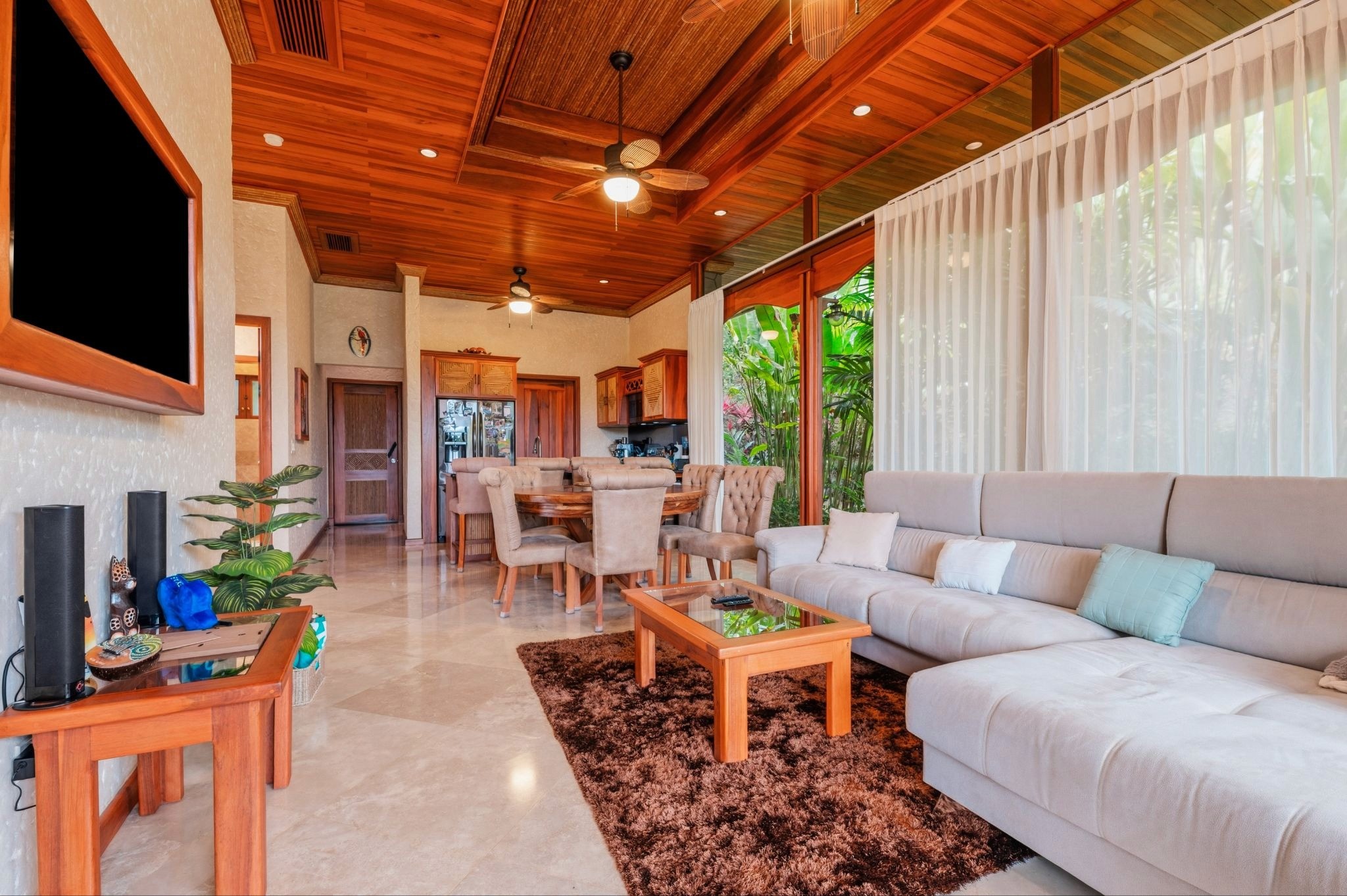
Material choices matter, too. Tropical hardwoods such as teak and laurel are commonly used because they’re well suited to warm, humid environments, while stone, marble, and other durable natural materials work particularly well in a rainforest setting.
At Arenal Hills, that climate-conscious material palette is part of the architecture itself, with native hardwoods, teak, laurel, stone, Peruvian marble, glass, and custom woodwork used throughout the Signature Villa Designs.
The point isn’t that every house in the Arenal region needs exactly the same materials. It’s that the materials should make sense for where the home is built, rather than simply looking good on the day you tour it.
Glass, Light, and Airflow
Expansive glass is one of the great pleasures of rainforest architecture. It brings natural light into the home, keeps you visually connected to the landscape, and – on the right homesite – lets Arenal Volcano become part of the room.
But glass, hardware, seals, ventilation, and airflow all need to be selected and maintained with humidity in mind. Cross-ventilation, generous ceiling heights, and openings that can still function when it rains help a home feel fresh and comfortable throughout the year.
None of this is unusual or complicated when it’s addressed from the beginning. It’s simply what thoughtful design looks like in a warm, lush, fast-growing environment – and it’s one of the things worth paying attention to when you’re comparing real estate in La Fortuna and the wider Arenal region.
Privacy That Grows – and the Care That Comes With It
One of the most beautiful things about owning in the Arenal region is that privacy can feel remarkably natural here.
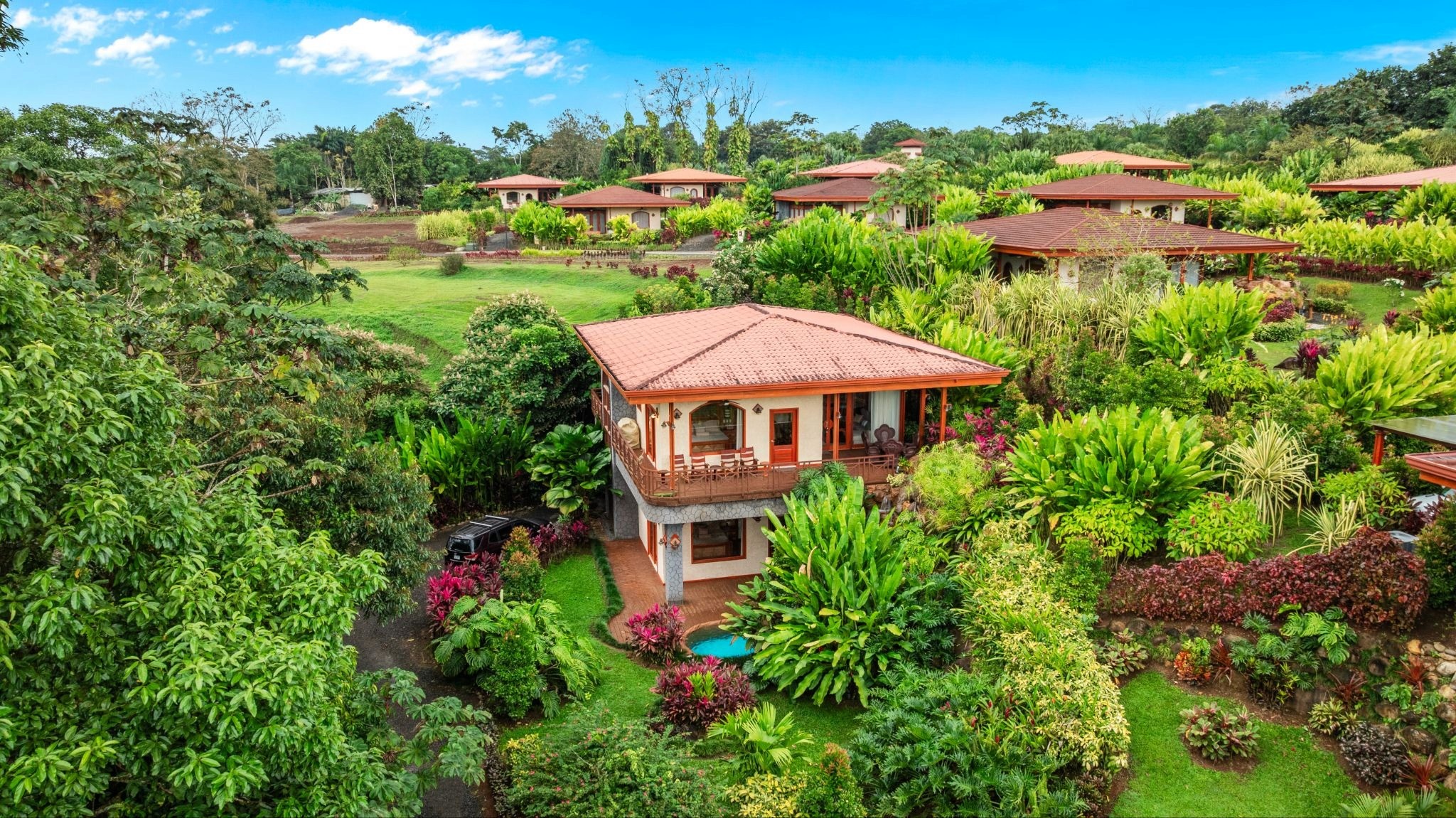
Privacy is often grown rather than built. Lush plantings, tropical gardens, and dense vegetation create separation between homes without requiring the landscape to be divided by walls at every turn. As those plantings mature, even a relatively manageable homesite can begin to feel wonderfully secluded. That’s what we mean by living privacy: a sense of retreat created by rainforest and landscaping rather than simply by distance.
Of course, everything that grows also needs care. Tropical landscaping develops quickly, and a home that sits unattended for several months still needs someone keeping an eye on gardens, exterior surfaces, drainage, pools, systems, and all the small things that keep a property feeling ready for your return.
For anyone planning to own a home in La Fortuna part-time, that makes on-site property care particularly valuable. The same landscape that creates the privacy, greenery, and restorative quality people fall in love with also needs regular attention.
That isn’t really a downside of rainforest ownership so much as part of understanding what you’re buying. With the right design and the right care behind it, the lushness isn’t something you have to work around. It becomes one of the reasons the home feels the way it does.
Where Arenal Hills Fits
Read back through the questions above – about climate, materials, maintenance, privacy, infrastructure, and what happens to a home when you’re away – and Arenal Hills is, in many ways, a response to them.
Arenal Hills is a private resort-style community of luxury homes and vacation residences near La Fortuna, surrounded by lush rainforest, mountain landscapes, and views toward the iconic Arenal Volcano. Developed by Gerald Baum and Costa Rica Land Capital Partners, the community was designed around the realities of owning in this particular part of Costa Rica: beautiful, green, fast-growing, and better enjoyed when the practical side of ownership is already thoughtfully supported.
Hospitality-Level Architecture, Designed for the Arenal Landscape
The architecture is hospitality-informed and deeply connected to the setting. Arenal Hills’ Signature Villa Designs – Villa Torres, Villa Ramírez, Villa Seville, Villa Fleta, and Villa Bernabé – draw on architectural experience connected to two of La Fortuna’s best-known luxury hospitality properties, The Springs Resort & Spa and Nayara Resort.
Each design has its own layout and character, but the broader architectural language is consistent: expansive glass, generous indoor-outdoor living, native hardwoods, stone, Peruvian marble, custom woodwork, covered outdoor spaces, and openings that keep the rainforest, gardens, mountains, water, and Arenal Volcano connected to the experience of the home.
The villa names themselves come from classical guitar makers and master luthiers – a subtle nod to Gerald Baum’s musical background and to the idea of craftsmanship that runs through the homes. It isn’t about decoration for decoration’s sake. It’s about choosing materials and details that feel appropriate to the place and built to be lived with over time.
A Private Resort-Style Community
Arenal Hills isn’t simply a group of homes sharing an entrance. Resort-inspired amenities are woven into the community, giving owners the option to move easily between quiet time at home and something more active or social.
Depending on where you are in the community, that can mean time at Club Cabana, the lake and kayaking areas, gym and sauna, pickleball court, lookout point, walking trails, pool areas, the river and tubing deck, or simply moving through a landscape designed around rainforest, gardens, water, and open green space.
Just as importantly, the infrastructure behind the lifestyle is already part of the community: underground utilities, high-speed fiber-optic internet, maintained common areas, access-controlled entry, landscaping, and an on-site operations team.
Supported Ownership When You’re Here – and When You’re Away
For many international buyers, the practical difference is what happens between visits.
At Arenal Hills, supported ownership brings together on-site property care, community maintenance, landscaping, access systems, and a managed vacation-rental pathway. The goal isn’t to make ownership feel impersonal; it’s to make it easier to enjoy a rainforest home base without having to rebuild the support system every time you leave Costa Rica.
That distinction is easier to see side by side:
Ownership Consideration | Independent Open-Market Purchase | Arenal Hills |
Home or build path | May be an existing standalone home, raw land, or an independent build | Signature Villa Design through Custom Build, completed developer inventory, or private resale |
Architecture and construction | Depends on the individual property, architect, builder, or prior owner | Unified architectural framework designed for the Arenal setting |
Infrastructure | Verified individually as part of property due diligence | Community infrastructure is integrated into the master plan |
Shared amenities | Depends entirely on the property or community | Resort-inspired community amenities |
Property care | Arranged independently by the owner | On-site property care and community maintenance available within the ownership structure |
Rental support | Arranged independently, if desired | Managed vacation-rental pathway for eligible villas |
Neither structure is automatically the right choice for every buyer. The distinction is really about how independently you want to manage the home, its infrastructure, and its ongoing care.
Three Ways to Buy at Arenal Hills
Arenal Hills also gives buyers more than one way into the community:
Purchase Path | Designed For |
Arenal Hills Custom Build | Buyers who want to select a Signature Villa Design, choose from the homesites approved for that design, select an available finish and furnishing level, and personalize the home before construction |
Arenal Hills Immediate Occupancy | Buyers who prefer a completed, developer-owned villa without the Custom Build timeline |
Arenal Hills Private Resale Collection | Buyers purchasing an existing privately owned villa within the community |
For Custom Build buyers, the process begins with the villa design rather than with a blank homesite. Once you’ve chosen the Signature Villa Design that fits how you want to live, the team introduces you to the compatible available homesites, followed by the applicable Silver, Gold, or Platinum finish and furnishing options.
Villas at Arenal Hills currently start from US$525,000, with final pricing depending on the Signature Villa Design, homesite category, and finish level. Pricing and availability are current as of 2026 and should always be confirmed directly with the Arenal Hills sales team.
Owners also receive membership privileges with The Springs Resort & Spa, one of La Fortuna’s most recognized luxury resort properties, under defined membership terms. These privileges are reserved for owners and do not extend to vacation rental guests.
Frequently Asked Questions About La Fortuna Costa Rica Real Estate
Can Foreigners Buy Real Estate in La Fortuna, Costa Rica?
Yes. Foreign buyers can own ordinary titled property in La Fortuna under the same basic fee-simple ownership structure available to Costa Rican citizens, without a citizenship or residency requirement. Because La Fortuna is inland, the maritime-zone concession rules that apply to certain coastal properties don’t apply to ordinary titled real estate here.
What Kinds of Homes Are for Sale in La Fortuna, Costa Rica?
Homes for sale in La Fortuna, Costa Rica range from standalone residences and rural properties to vacation homes, independent building opportunities, and villas within a smaller number of gated or master-planned communities. Buyers can purchase an existing home, build independently, or choose a guided Custom Build within a community such as Arenal Hills.
What Are Closing Costs When Buying Property in Costa Rica?
A useful planning range for total closing costs is approximately 3.5% to 6.5% of the purchase price, although the exact amount depends on the transaction and services involved. Standard components include a 1.5% property transfer tax, applicable registry and documentary stamps, and notary and legal fees. How costs are allocated between buyer and seller is negotiable.
How Much Rain Does the Arenal Region Get?
La Fortuna receives roughly 2,200 to 2,450 millimeters (86 to 96 inches) of rain annually, depending on the dataset. The region sits on the Caribbean side of Costa Rica’s continental divide, so rainfall is spread differently across the year than it is along much of the Pacific coast. That consistent moisture is what keeps the Arenal landscape lush and green.
What Should I Look for in a Home Built for La Fortuna’s Climate?
Look beyond finishes to the fundamentals: thoughtful siting and drainage, generous roof overhangs, good airflow and ventilation, durable materials, and exterior spaces designed to remain usable when it rains. Tropical hardwoods, stone, glass, and other climate-appropriate materials are common because homes here need to work comfortably with humidity, rainfall, and fast-growing vegetation.
What Is the Annual Property Tax in Costa Rica?
Costa Rica’s annual municipal property tax is 0.25% of the property’s registered taxable value. For 2026, residential properties whose taxable construction value exceeds ₡143 million may also be subject to the progressive impuesto solidario, beginning at 0.25%. Because the threshold is periodically reviewed, current figures should be confirmed with a Costa Rican tax professional.
How Much Do Homes at Arenal Hills Cost?
Arenal Hills villas currently start from US$525,000. Final pricing depends on the Signature Villa Design, compatible homesite category, and applicable Silver, Gold, or Platinum finish and furnishing level. Buyers can also explore Custom Build opportunities, completed developer inventory, and private resales within the community. Current pricing and availability should always be confirmed with the Arenal Hills sales team.
What Matters Most When Buying in La Fortuna
The more you understand La Fortuna Costa Rica real estate, the clearer it becomes that buying here isn’t only about finding the right view or the right price. The fundamentals matter: titled ownership, thoughtful due diligence, infrastructure, architecture that makes sense for the climate, and a realistic plan for caring for the property when you’re away.
The rainforest is part of that equation, but it’s also the reason so many people are drawn here in the first place. The rain feeds the landscape, the vegetation creates privacy, and the year-round greenery gives the Arenal region the deeply rooted sense of place that makes it feel so different from many other Costa Rican real estate markets.
Choose a home designed for the environment, with the right care behind it, and it becomes part of the reason you chose La Fortuna in the first place.

Arenal Hills Sales Team
Tel: +1 (201) 907-2898
Email: hello@arenalhills.com
Arenal Hills Office
C. 474 50, Provincia de Alajuela, La Fortuna, 21007, Costa Rica
Map →
CR Tel: +506 8484 4642
US Tel: +1 (844) 694 4557
Email: arlene@arenalhills.com
Arenal Hills Florida Office
5331 Spring Hill Drive, Spring Hill, Florida 34606
Arenal Hills Community
Tres Esquinas, Los Ángeles, San Ramón, Alajuela, Costa Rica, 20208.
Map →
Arenal Hills is a development of Costa Rica Land Capital Partners, LLC, a Florida limited liability company, Florida Document No. L07000012341.
© 2026 Costa Rica Land Capital Partners, LLC. All rights reserved.