
Buying in Costa Rica
Costa Rica Residency by Investment: What Real Estate Buyers Should Know
If you’re researching Costa Rica residency by investment, chances are that a property purchase and residency paperwork aren’t where your story starts.
More often, it starts with wanting to spend more time here. Maybe you’ve been coming to Costa Rica for years and the trips keep getting longer. Maybe you’re looking ahead to retirement, thinking about a second home, or realizing that working remotely gives you more freedom than it used to. Eventually, the question shifts from Could I own a home here? to, Could owning that home also help me stay here legally?
The short answer is potentially, yes.
Costa Rica has an investor-residency category known as Inversionista residency, and qualifying real estate can be used as the investment behind an application. But buying a home and becoming a resident are still two separate legal processes, meaning that property ownership doesn’t automatically grant residency, and you don’t need residency simply to own most titled real estate in Costa Rica.
That distinction gives international buyers more flexibility than you might expect. You can begin with a vacation home or part-time residence, spend time getting to know the country and the way you actually use the home, and decide later whether legal residency belongs in your longer-term plans.
With all that in mind, this guide explains how Costa Rica residency through real estate investment works, what investor residency actually gives you, how property ownership fits into the process, and what you should confirm before structuring a real estate purchase around immigration eligibility.
Note: This article provides general information about Costa Rican real estate and immigration as of September 2026. It isn’t legal, immigration, tax, or financial advice. Immigration rules and their interpretation can change, so buyers considering property as part of a residency application should confirm current requirements with a qualified Costa Rican immigration attorney.
Can Buying Property in Costa Rica Help You Get Residency?
Yes, qualifying real estate can potentially support an application for Costa Rica investor residency.
Costa Rica’s immigration system includes investors within its temporary-resident categories, and the regulations governing Inversionista residency expressly recognize real estate as one of the forms an eligible investment can take. Investor residency is generally granted initially for two years and may be renewed if the applicable requirements continue to be met.
The important word here is application: Buying property doesn’t turn a foreign owner into a Costa Rican resident automatically. Your real estate purchase establishes the investment; the residency process is separate and requires its own application, documentation, and approval through Costa Rica’s immigration authorities.
For someone already planning to buy a home, this separation is actually a benefit: It’s a possibility, not a requirement. You don’t have to decide on the first day of ownership whether Costa Rica will eventually become your primary home. Instead, ease on in. Begin with a vacation residence, spend several months here each year, and explore residency later as your plans evolve.
Or, by all means – buy a home with the intention of becoming a resident. The separation of real estate law and residency law gives you that flexibility and agency, always.
Can Foreigners Own Property in Costa Rica Without Residency?
Yes. Foreigners can generally purchase and hold ordinary titled real estate in Costa Rica without first becoming legal residents.
An American, Canadian, or other international buyer can own a second home or vacation residence while continuing to enter the country under whatever immigration status is appropriate for their stays.
There are special rules for certain kinds of property, most notably land governed by Costa Rica’s Maritime Terrestrial Zone along portions of the coastline. But ordinary inland titled property – such as real estate in La Fortuna and the Arenal region – isn’t subject to that coastal concession system.
Note: If you want the ownership side in more detail, our guide to Can Americans Buy Property in Costa Rica? explains titled ownership, the property registry, maritime-zone rules, and the buying process more fully.

How Costa Rica Investor Residency Works
Costa Rica’s Inversionista category is a form of temporary legal residency for qualifying foreign investors. You’ll often see people searching for a Costa Rica investment visa, Costa Rica investor visa, or even a “golden visa,” but technically, Costa Rica treats Inversionista as a residency category rather than a visa.
Real estate is one of several investment types recognized under the current regulatory framework. The regulations also contemplate other forms of qualifying investment, including certain registrable movable assets, shares, securities, productive projects, projects of national interest, venture-capital funds, and qualifying sustainable-tourism infrastructure.
For a real estate buyer, though, the basic sequence is much easier to understand:
You make the qualifying investment. In this context, that may be the purchase of qualifying Costa Rican real estate.
You document the investment. Your residency application needs evidence showing that the investment exists and satisfies the requirements applicable to the category. For real estate, this can include National Registry, ownership, valuation, and other supporting documentation.
You apply separately for residency. Legal property ownership itself isn’t the same as immigration approval. The two public institutions don’t automatically speak to each other.
Investor residency begins as temporary residency. Costa Rica’s General Immigration Law places investors in the temporary-resident category, generally for up to two years at a time.
You maintain the qualifying conditions. The current investor regulation requires the investment to be maintained continuously for renewal of the residency category.
After three consecutive years of qualifying temporary residency, Costa Rican law allows temporary residents, including investors who otherwise meet the requirements, to apply for permanent residency. Note that again, the transition isn’t automatic; it’s a separate immigration step with its own requirements.
To be very clear, current Costa Rican law doesn’t provide for a citizenship-by-purchase program (though it does open a path to citizenship), and it isn’t a system where handing over the keys to a property also hands you permanent residency. It’s better understood as an optional immigration pathway built around a qualifying investment.
For many property owners, that fits quite naturally with the way life in Costa Rica develops. The home may come first. Longer stays may follow. Residency becomes relevant when (and if) you decide you want a more permanent legal relationship with the country.
How Much Do You Need to Invest for Costa Rica Residency?
This is the part of Costa Rica residency by investment that deserves a little extra explanation right now.
Law 9996 reduced the qualifying investment amount for Inversionista residency to US$150,000, and the current implementing regulation still states that amount. At the same time, the five-year period created by Law 9996 reached its endpoint in July 2026, and Costa Rican legal professionals don’t currently agree on what that means for new applications.
Some attorneys are advising that the minimum has returned to the previous US$200,000 threshold. Others point out that the current regulation still says US$150,000 and that the law doesn’t clearly establish an automatic return to US$200,000.
So, as of September 2026, this is still a developing area.
If you’re buying property specifically because you want it to support an investor-residency application, the most useful approach is also the simplest: confirm the threshold being applied to new applications with a qualified Costa Rican immigration attorney before you structure the purchase around it.
For Arenal Hills buyers, there’s a little less practical uncertainty around the purchase price itself, as your purchase here will meet either established investment minimum. Of course, that doesn’t mean an Arenal Hills purchase automatically qualifies you for residency; you’ll still need to undergo the immigration process and approval from Migración, the Immigration Office.
Should You Buy Costa Rica Property in Your Personal Name or Through a Corporation?
If Costa Rica investor residency is part of your plan, this is a question to answer before you close, not after.
Foreign buyers can generally purchase titled Costa Rican real estate either in their own name or through a Costa Rican legal entity, commonly an S.A. or S.R.L. Neither structure is automatically better; they simply work differently, and the choice can affect estate planning, administration, taxation, liability, and, importantly here, how an investment is presented for immigration purposes.
Personal Ownership vs. Corporation Ownership
At a high level, here’s the distinction:
Buying in your personal name: The connection between you and the real estate is direct: you’re the registered owner of the property. For an investor-residency application based specifically on real estate, that can make the investment relationship easier to document.
Buying through a corporation: The corporation becomes the registered owner of the property, while you own shares or membership interests in that company. Costa Rica’s investor-residency framework also recognizes qualifying investments in company shares, but the documentation and valuation requirements aren’t necessarily the same as an application based directly on personally owned real estate.
Your percentage of ownership can matter: If a company has more than one shareholder, immigration counsel may need to establish the value attributable specifically to the applicant rather than simply relying on the total value of the property held by the company.
The best real estate structure isn’t automatically the best immigration structure: A company may make sense for one buyer’s estate-planning, management, or liability objectives while direct ownership may be easier for another buyer’s residency strategy. That’s why the real estate and immigration conversations should happen together if residency is already part of the plan.
The takeaway isn’t that you should always buy personally or always use a corporation. It’s that you shouldn’t choose the ownership structure first and ask how it affects residency later.

What Documents Are Typically Needed for Costa Rica Investor Residency?
The exact list depends on your circumstances and the requirements in effect when you apply, but investor-residency applications commonly involve documents such as:
A valid passport: You’ll need current identification and evidence relating to your legal entry and immigration status.
Birth documentation: A birth certificate issued in your country of origin is generally part of the application file.
Criminal-background records: Applicants may need current criminal-record documentation from the applicable country or countries.
Apostilles or legalization: Foreign-issued documents generally need to be properly apostilled or legalized before they can be used in Costa Rica.
Translations where required; Documents that aren’t accepted in their original language may need an official Spanish translation.
Proof of the investment: For a real-estate-based application, this may include National Registry, municipal, valuation, ownership, or other documentation showing the qualifying investment and its connection to the applicant.
Corporate documentation, when applicable: If the investment is being presented through company shares rather than direct personal ownership, additional corporate, shareholder, tax, and valuation documentation may be required.
This is one of those areas where getting organized early can save you a great deal of backtracking. If residency is part of your purchase plan, ask your immigration attorney what they’ll need before the property closes and before foreign documents begin expiring.
Can Your Spouse or Family Apply With You?
Potentially, yes.
Costa Rica’s immigration framework allows certain qualifying family members to obtain legal status in connection with a principal resident, although the exact process depends on the relationship, age, dependency, and immigration category involved.
For a couple or family planning on moving to Costa Rica, it’s worth looking at the household as a whole from the beginning:
Spouses: Marriage documentation will generally be needed to establish the relationship.
Children and other qualifying dependents: Birth certificates and evidence of the applicable family or dependency relationship may be required.
Foreign civil records: As with the principal applicant’s documents, marriage and birth records issued abroad may need apostilles, legalization, and, where applicable, translation.
In other words, don’t structure the property and residency plan around one person and assume the rest of the family can simply be added later. A qualified immigration attorney can tell you how the principal application and related family applications should be organized together.
What Happens After You Get Investor Residency?
If your Inversionista application is approved, you start out as a temporary resident of Costa Rica.
Temporary residents are generally granted status for a defined period of up to two years, with the possibility of renewal as long as they continue to meet the applicable requirements.
Note that once residency is approved, residents are also generally required to enroll with Costa Rica’s public healthcare system, the Caja Costarricense de Seguro Social (CCSS), as part of completing their resident status.
From there, the path can continue:
Maintain your qualifying residency: Investor residents need to keep meeting the conditions tied to their immigration category, including the requirements applicable to the qualifying investment.
Renew when required: To maintain your resident status, complete the applicable renewal process and maintain the documentation required for your category.
Apply for permanent residency later: After three consecutive years of temporary residency, qualifying residents can apply for permanent residency. That isn’t automatic; it’s another immigration application with its own requirements.
Citizenship is a separate step again: Costa Rica doesn’t offer citizenship by investment. Residency can eventually become part of a longer path toward naturalization, but buying property itself doesn’t shorten that process into a direct citizenship program.
For a second-home owner, that sequence can actually feel quite natural. You may begin with a home you use for vacations or several months at a time, move into legal residency once you’re spending more of your life here, and only later decide whether permanent residency (or eventually, citizenship) belongs in the picture.
Does Costa Rica Residency Make You a Tax Resident?
Not automatically.
Costa Rica keeps immigration residency and tax residency separate, which is another reason not to assume that receiving your DIMEX or changing your immigration status answers every tax question.
Under Costa Rica’s income-tax regulations, an individual can generally be considered fiscally domiciled in Costa Rica after spending more than 183 days in the country during the applicable tax period, including certain short absences in the calculation, unless another tax residence can be demonstrated.
Law 9996 also expressly states that investors, Pensionados, and Rentistas aren’t treated as Costa Rican tax residents simply because they hold one of those immigration categories.
For most property buyers, the practical takeaway is simple: if you begin spending substantial time in Costa Rica, receiving rental income, operating a business, or shifting your primary life here, speak with a Costa Rican tax professional rather than assuming your immigration status tells you everything you need to know.
What Property Taxes Should Buyers Know About?
Property taxes are separate from immigration residency, but they’re still part of the bigger ownership picture.
A few basics are worth knowing:
Municipal property tax: Costa Rican municipalities generally levy an annual property tax of 0.25% of the property’s registered taxable value.
Transfer tax: When real estate changes ownership, Costa Rica generally applies a 1.5% property transfer tax as part of the closing process.
Impuesto solidario: Certain higher-value residential properties may also be subject to Costa Rica’s progressive luxury-home tax. For 2026, the tax applies when the value of the residential construction and fixed installations exceeds ₡143 million, with rates beginning at 0.25%.
Other ownership costs vary by property: Insurance, utilities, maintenance, community fees, landscaping, and property management aren’t immigration costs and shouldn’t be folded into a residency calculation.
Note: We cover the real-estate side in much more detail in our guide to La Fortuna Costa Rica real estate, including closing costs, property taxes, and what ongoing ownership in the Arenal region can actually look like.
Investor Residency vs. Other Costa Rica Residency Options
Buying property doesn’t automatically mean Inversionista is the best – or even the most useful – residency path for you.
Costa Rica offers different legal categories for different circumstances, and the right fit often depends less on the home you’re buying than on why you’re spending more time here in the first place.
Inversionista Residency
Best suited to qualifying investors, including some real estate buyers.
If your purchase satisfies the investment requirements in effect when you apply, qualifying real estate may support an Inversionista application. For someone already making a substantial Costa Rica real estate investment, that can be a natural category to explore.
Pensionado Residency
Designed for applicants with a qualifying lifetime pension income.
Costa Rica’s Pensionado category currently requires proof of a permanent monthly pension of at least US$1,000 from abroad. This is what many people mean when they search for a Costa Rica retirement visa or Pensionado visa Costa Rica, although it is technically a temporary-residency category rather than a visa.
For a retiree who already meets the pension requirement, Pensionado may make more sense than structuring a property purchase around investor residency.
Rentista Residency
Designed for people who can demonstrate a qualifying stable income.
Current law requires Rentista applicants to demonstrate at least US$2,500 per month in stable income from abroad or qualifying Costa Rican banking sources. The law also allows the principal applicant to cover qualifying dependents under the same amount.
Again, no real estate purchase is required simply to qualify under this category.
Digital Nomad Stay
Designed for qualifying remote workers and service providers earning income from outside Costa Rica.
Costa Rica’s digital nomad program is different from the traditional residency categories above: it is an Estancia, or authorized stay, rather than conventional temporary residency. Current requirements generally include foreign-sourced monthly income of at least US$3,000 for an individual, or US$4,000 when applying with qualifying dependents.
The larger point is that there isn’t one universally “best” path. A retired buyer, a remote-working couple, a family purchasing a second home, and someone planning a future full-time move may all own Costa Rican real estate – and still have completely different immigration options.
That’s why it makes sense to begin with your actual plans rather than with the name of the residency category.
What Residency Can Mean for a Second-Home Owner
We understand that not every international buyer who purchases property in Costa Rica is planning an immediate full-time move. In fact, for many people, the relationship with the country develops much more gradually than that.
You may begin with a vacation home and spend a few weeks here at a time. Then the visits get longer. Maybe retirement moves closer, remote work gives you more flexibility, or you simply realize that Costa Rica has become less of a destination and more of a place where part of your life happens.
That’s often when residency starts to feel relevant. If you’re a second-home owner, legal residency can become part of a longer-term plan rather than something you need to solve before buying. The progression might look something like this:
You start with a home: You purchase a vacation residence or second home because you want a place of your own in Costa Rica.
You begin staying longer: What started as a few trips each year becomes several weeks or months at a time.
Your plans evolve: Retirement, remote work, family priorities, or simply wanting more time here may shift Costa Rica into a larger role in your life.
Residency becomes useful: At that point, it may make sense to explore a legal residency category that better fits how you’re actually living.
For some owners, that happens quickly. For others, it may be five or ten years down the road. And for plenty of people, part-time ownership remains exactly what they want. The flexibility is baked in, and we’re all the better for it.
If you're picturing what that longer stay actually looks like, our Living in La Fortuna, Costa Rica: A Resident's Guide covers the climate, healthcare, and daily rhythm of the Arenal region.
Real Estate, Residency, and Life at Arenal Hills
That kind of flexibility is very much part of your ownership journey at Arenal Hills.
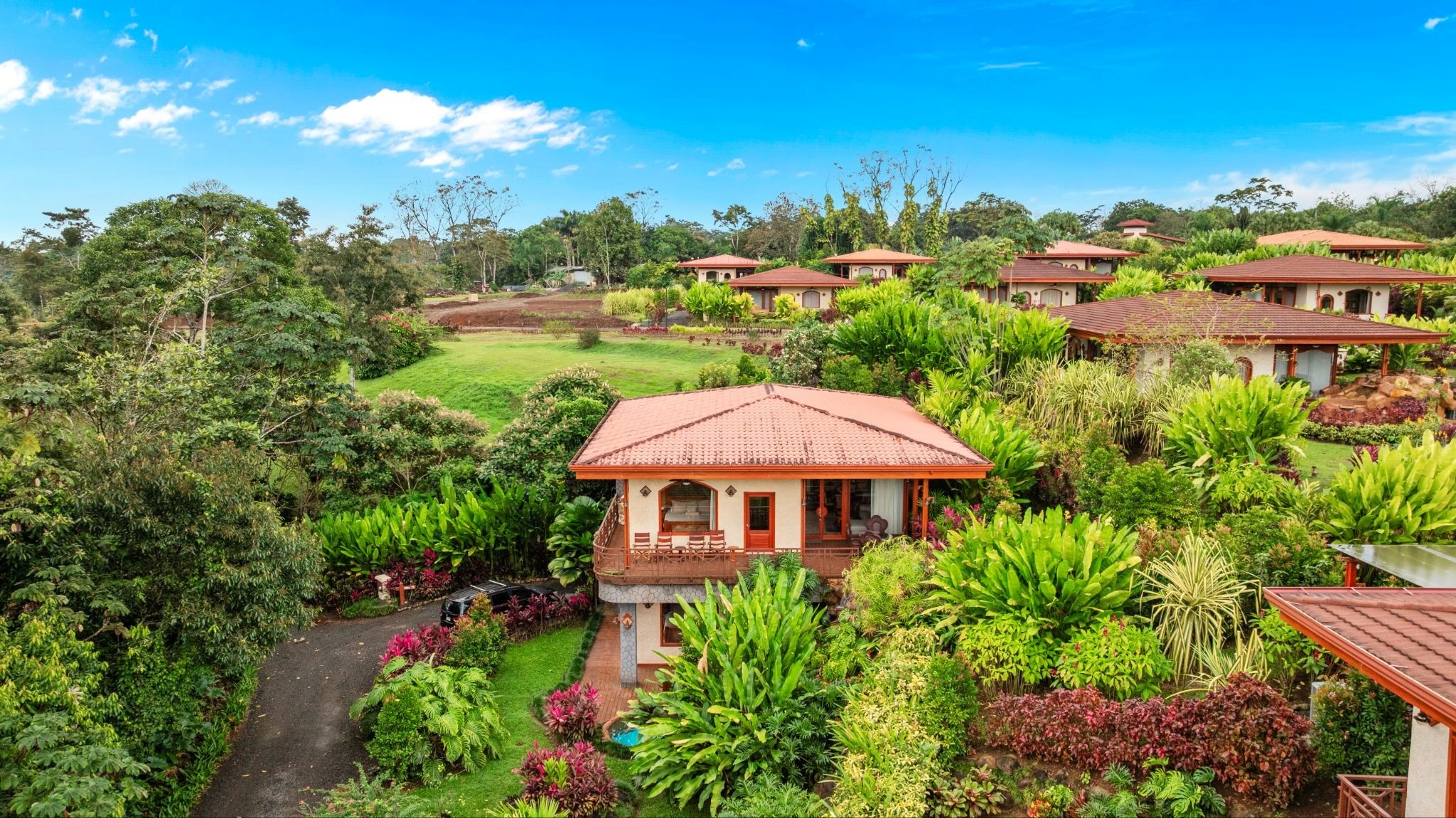
Arenal Hills is a private resort-style community near La Fortuna, designed for people who may use their home in different ways over time: as a vacation residence, a part-time home base, a place for extended stays, or eventually somewhere they spend a much larger part of the year.
The point isn’t that every Arenal Hills owner needs residency. Many don’t, in fact. The point is that you can own and enjoy a villa in Costa Rica without becoming a legal resident, and for some buyers, that may remain the right fit indefinitely. But if your relationship with Costa Rica changes, our ownership structure at Arenal Hills gives you room to change with it.
Our community is built around supported ownership: combining the experience of having a private home in the rainforest with the practical systems, community environment, and support that can make international ownership feel more manageable.
Considering a Home in La Fortuna?
For buyers exploring Costa Rica residency by investment, owning a home is rarely just a real estate decision; it can become the beginning of a much longer relationship with the country, a place to return to rather than simply somewhere to visit.
Arenal Hills offers a private resort-style community near La Fortuna, with Signature Villa Designs and homes currently available for purchase, created for vacation-home ownership, part-time living, extended stays, and, for some owners, full-time residence.
Speak with our team to explore the right ownership pathways for your plans in Costa Rica.
Frequently Asked Questions About Costa Rica Residency and Real Estate
Can Buying Property in Costa Rica Give You Residency?
Potentially, but not automatically. Qualifying real estate may support an application for Costa Rica’s Inversionista temporary-residency category, but the property purchase and residency application are separate legal processes. You still need to satisfy the applicable investment, documentation, ownership, and immigration requirements.
How Much Property Do I Need to Buy to Get Residency in Costa Rica?
As of September 2026, the applicable investment threshold for new investor-residency applications remains an area of developing legal interpretation. Law 9996 established a US$150,000 threshold, while some current legal guidance advises that the requirement has returned to US$200,000 following the end of the law’s five-year period.
Because both interpretations are currently appearing in Costa Rican legal guidance, confirm the threshold being applied to new applications with a qualified immigration attorney before purchasing specifically for residency.
Is There a Costa Rica Golden Visa?
Costa Rica doesn’t officially have a program called a Costa Rica golden visa.
People using that search term are generally looking for the country’s Inversionista residency category, which allows certain qualifying investments – including qualifying real estate – to support an application for temporary residency.
Unlike some international “golden visa” programs, purchasing Costa Rican real estate doesn’t automatically grant permanent residency or citizenship.
Does Costa Rica Offer Citizenship by Investment?
No. Costa Rica doesn’t offer direct citizenship by investment.
A qualifying investment may support an application for temporary Inversionista residency. Temporary residency can potentially lead to permanent residency after the applicable requirements are met, and legal residency may eventually become part of a path toward Costa Rican citizenship.
Naturalization is a separate process, though, with its own residency periods, eligibility rules, and requirements. Buying property itself doesn’t grant citizenship.
Can Americans Own Property in Costa Rica?
Yes. Americans, Canadians, and other foreign nationals can generally own ordinary titled real estate in Costa Rica without first obtaining residency or citizenship.
Special rules apply to certain properties, particularly within Costa Rica’s Maritime Terrestrial Zone, but ordinary titled inland real estate can generally be owned by foreigners under the same basic ownership framework available to Costa Rican citizens.
Do I Need Residency to Own a Vacation Home in Costa Rica?
No. You can own a vacation home or second residence in Costa Rica without becoming a legal resident.
Residency becomes a separate consideration if you want a more permanent immigration status, begin spending substantially more time in Costa Rica, or decide that the country is becoming a larger part of your long-term plans.
Is Investor Residency the Same as a Costa Rica Investment Visa?
Not technically. You may see the terms Costa Rica investment visa, Costa Rica investor visa, or investor visa Costa Rica used online, but Inversionista is a temporary-residency category under Costa Rican immigration law rather than a visa in the conventional sense.
The underlying search intent is the same: a qualifying foreign investor is looking for a legal pathway to reside in Costa Rica based on an eligible investment.
Is Investor Residency Better Than a Costa Rica Retirement Visa?
Not necessarily. Someone researching a Costa Rica retirement visa or Pensionado visa Costa Rica may qualify for Pensionado residency based on eligible pension income without needing to make a qualifying real estate investment. Likewise, a Rentista visa pathway may suit applicants who meet the applicable income requirements. The fact that you’re buying property doesn’t automatically make Inversionista your best residency option.
Can an Arenal Hills Home Potentially Qualify for Investor Residency?
Potentially, yes, provided the purchase, ownership structure, documentation, and application satisfy the immigration requirements in effect when you apply. Current Arenal Hills villa pricing is above both the US$150,000 and US$200,000 thresholds currently appearing in legal discussion. That means the purchase price itself is above either figure, but price alone doesn’t guarantee residency eligibility. If investor residency is part of your plan, have your specific Arenal Hills purchase and proposed ownership structure reviewed by qualified Costa Rican immigration counsel before closing.
Can Investor Residency Eventually Become Permanent Residency?
Yes, potentially. Investor residency begins as temporary residency. After three consecutive years of qualifying temporary residency, an eligible resident may apply for permanent residency, subject to the requirements in effect at that time. The change isn’t automatic, and permanent residency is still separate from citizenship.

Arenal Hills Sales Team
Tel: +1 (201) 907-2898
Email: hello@arenalhills.com
Arenal Hills Office
C. 474 50, Provincia de Alajuela, La Fortuna, 21007, Costa Rica
Map →
CR Tel: +506 8484 4642
US Tel: +1 (844) 694 4557
Email: arlene@arenalhills.com
Arenal Hills Florida Office
5331 Spring Hill Drive, Spring Hill, Florida 34606
Arenal Hills Community
Tres Esquinas, Los Ángeles, San Ramón, Alajuela, Costa Rica, 20208.
Map →
Arenal Hills is a development of Costa Rica Land Capital Partners, LLC, a Florida limited liability company, Florida Document No. L07000012341.
© 2026 Costa Rica Land Capital Partners, LLC. All rights reserved.